May 10, 2026
The new season pass strategy is working well for Six Flags, and the company is doubling down on that strategy by expanding live entertainment, adding more family-friendly offerings, and improving the in-park experience (ride uptime, maintenance, etc.).
The Numbers
Attendance and revenue at Six Flags’ theme parks grew, with 2.9 million visitors, a 4% increase from the same period last year. Net revenues grew 12% to $225.6 million, driven by a 6% increase in per capita spending to $69.26.
Operating costs fell by $50.4 million in Q1, a 12% reduction due to a few items:
- Headcount: staffing cuts and park sales.
- Operating supplies were down $8.2 million.
- Maintenance was down $9.5 million, driven by three factors: part disposal-related (the EPR parks), part calendar-related (24 fewer operating days), and part deferred spending committed to reversing in Q2 to support ride uptime and train availability.
Regional Passes are The New Moat
Consumers are using the new regional passes to explore multiple Six Flags properties, and as CEO John Reilly explained during the call, there’s a lot of potential to ‘mine’ that:
“There’s considerable opportunity to further mine that… we’re seeing cross-park visitation much higher… For example, a guest in San Antonio… can go ride Tormenta in Arlington this summer. The same thing with a pass member at Knott’s can go see the new Looney Tunes area at Magic Mountain… There are implications for that in how we think about our catchment areas, our media spend, our pricing and other areas as we go forward.”
The active pass base now sits at approximately 5 million units, up 6% on a same-park basis.
Expanded Live Entertainment
Reilly is also investing in giving passholders a reason to return, with more live entertainment.
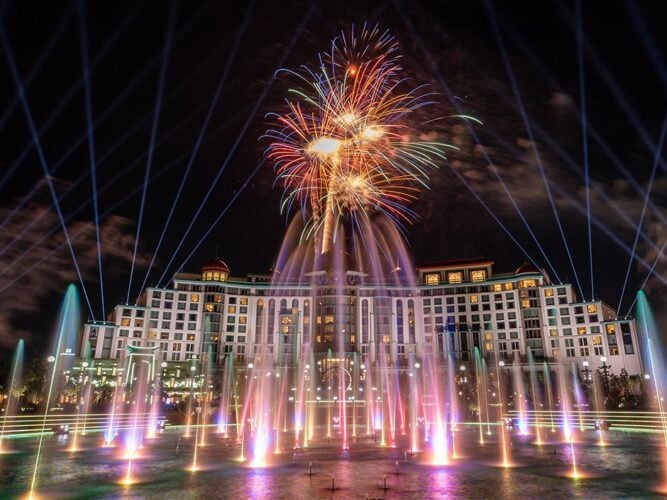
Kings Dominion announced an expanded Summer 2026 lineup that includes a new drone-and-fireworks show, an outdoor percussion show, a “Splash! Water Parade,” and an elevated indoor theatrical production called “Cirque Imagine.” On the holiday side, Six Flags is simultaneously rebuilding Holiday in the Park at Great Adventure in New Jersey and Six Flags Over Georgia. Both parks will debut three fully themed, immersive lands in 2026 as the first phase of a multi-year investment, following the 2025 event’s cancellation at both properties.
Adding More Family-Friendly Offerings
Following the same strategy of encouraging pass holders to return more often, leadership is also deliberately adding more family-friendly offerings to expand the audience. Basically, to encourage the whole family to come back multiple times or drive to a nearby park multiple times.
As Reilly put it on the call, the new programming and rebuilt seasonal events “are aimed at expanding our addressable audience and complementing the park’s core thrill business.”
Kings Island opened Phantom Theater on April 18, a revival of the family-targeted dark ride that closed in 1992. Six Flags Great Adventure announced Dead Man’s Party will return to Fright Fest 2026 after dropping the show from the 2025 lineup. The live music, choreography, and pyrotechnic production have run at the park since 1999, with the company framing it as “designed to be more fun than frightening” to reach guests who skip the haunted houses and scare zones. Both moves show Six Flags adding more entertainment for families that complements the thrills.
Improving the In-Park Experience
You can encourage families to return with robust live entertainment and seasonal offerings, but the basic creature comforts like ride uptime, maintenance, and security still need to be taken care of once they arrive. Reilly also has plans for that by increasing capex and reallocating funds to improve maintenance.
Q1 operating costs fell $50.4 million, including a $9.5 million reduction in maintenance. Reilly explicitly committed to reversing that line in Q2 to support ride uptime and train availability. The company also raised the FY2026 capital expenditure envelope to $425M-$450M, lifting the top end by $25 million from the $400M-$425M figure Reilly gave on the prior-quarter call. Interim finance lead Dave Hoffman previewed the operating-day calendar, projecting Q2 about 16 days shorter than Q2 2025 as the company optimizes day-by-day at each park, then about 20 days longer than 2025 across the full year once restored holiday, and Halloween programming runs in the back half. Reilly also pointed to procurement as the next cost lever, saying he has renegotiated with the company’s top 75 vendors and is reaching out to the next 400.
What Happens Next?
The regional passes put Six Flags in a strong position to address current uncertainty. Guests feeling the pressure of rising costs can ‘trade down’ to another Six Flags location instead of a more expensive vacation. For example, you could see a family driving to a nearby park they already have access to with their passes, rather than flying for a different vacation. The more Reilly adds live entertainment and seasonal events and cleans up the in-park experience, the more it compounds this effect by encouraging guests to return even more often.
Both Disney and Universal reported strong Q1 performance and demand, but I see this as two different strategies. If a guest is already committed to a resort destination trip to Disney or Universal, inflated energy costs are unlikely to deter them. The Six Flags strategy targets guests seeking more regional or local vacations where price is a greater concern.
Six Flags doesn’t plan to sell any parks in 2026, but it left the option open for future years, saying it allows them to focus more. The biggest drag on Six Flags is still its leverage. Net debt sits at $5.27 billion at Q1, putting the debt-to-EBITDA ratio above 6x. That is significantly above peers: Disney runs at approximately 2.4x, Comcast (Universal’s parent) at approximately 2.8x, SeaWorld at approximately 4.2x, and Merlin Entertainments at approximately 3.9x. Selling more parks in the future and getting more focused on what works is exactly what the change should be doing.