In-person shopping is returning, but only if it’s a good experience.
New research from Knight Frank’s “Retail Renaissance 2025“ report shows what the themed entertainment industry has been saying for years: people want to shop in physical spaces offering experiences you can’t get online (with a few caveats).
According to the report, retail achieved a total return of 8.1% in 2024, making it the best-performing commercial property class. Retail rents grew 2.3% last year, marking the first time since 2014 that all retail channels and sub-sectors saw simultaneous rental growth.
The BBC’s coverage of this shift, citing research from the same property consultants, notes that British retailers and investors have “reallocated capital back into physical stores, either by opening new shops or upgrading existing ones,” with the national shop vacancy rate falling to its lowest level since 2020. The report states that “our shopping habits have normalised since the pandemic, when millions of us depended on e-commerce,” and online retail sales growth has slowed sharply “not just in the UK, but in North America, Europe and parts of Asia.”
But here’s what matters for attractions professionals: the reason people are returning to physical retail isn’t nostalgia. It’s experience.
The act of Shopping is Social
Tweaking the Business Model
At traditional attractions, operators argue over value per minute and justify admission pricing. But in retailtainment, the experience can be free—the social space, the entertainment, the community gathering—and revenue comes from souvenirs that commemorate the memory.
As Scott mentioned in our show, the Harry Potter stores in New York and Chicago still have weekend queues just to enter. That’s not because people need merchandise that they could order online. It’s because the store offers community, socialization, and tactile connection—what the BBC identified as critical to physical retail’s return.
The Growth Potential
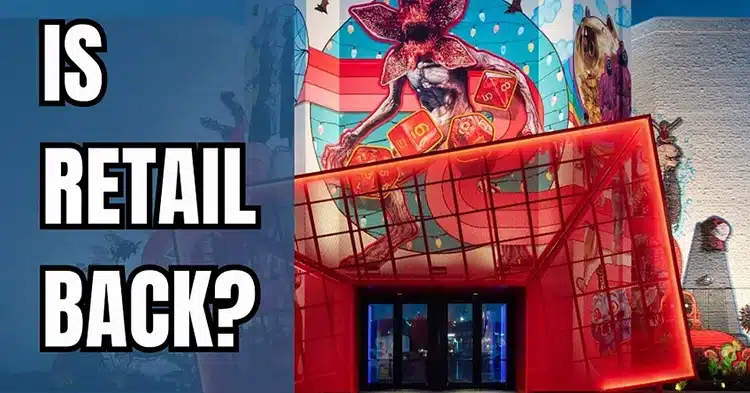
Retailtainment isn’t a new concept for the attractions industry— The Stranger Things stores, which preceded Netflix House, being a recent example, plus Disney Springs, Universal CityWalk, etc. However, I’d argue there’s significant growth potential that hasn’t been fully realized, particularly as traditional retail continues to discover what attractions professionals already know: experience sells.
Knight Frank’s conclusion is instructive: “there’s still a place for bricks and mortar – though only for space that’s better.” Not just more space, not cheaper space—better space. Space that offers what online can’t.
The experiences we create aren’t competing with Amazon. They’re providing what Amazon never can. And according to the institutional real estate market, that’s now the best-performing investment thesis in commercial property.
Immersive spaces that connect guests are our specialty.
Is Six Flags Preparing to Sell More Parks?
A series of trademark applications filed last week suggests that Six Flags may be preparing to sell additional properties, continuing the portfolio-reduction strategy implied by its recent debt refinancing.
What We Know (Facts):
An applicant named “Enchanted Parks Holdings, LLC,” which lists a downtown Orlando office tower as its address, filed trademark applications on January 11 for several names that correspond to current Six Flags properties:
Enchanted Parks Camping Resort
Enchanted Parks Galveston
Enchanted Parks Great Escape Lodge
Enchanted Parks Michigan Adventure
Enchanted Parks Oceans of Fun
Enchanted Parks St. Louis
Enchanted Parks Water Safari
Enchanted Parks Water’s Edge Inn
The address for Enchanted Parks Holdings traces to Innovative Attraction Management (IAM), an Orlando-based company that purchased Enchanted Forest Water Safari, Water’s Edge Inn, and Old Forge Camping Resort (all in Old Forge, NY) in 2024. IAM also owns Diggerland USA.
What We’re Inferring (Analysis):
The trademark pattern suggests IAM is consolidating its existing water park assets with potential Six Flags acquisitions under a unified “Enchanted Parks” consumer brand. This aligns with Six Flags’ publicly stated strategy outlined in their November Q3 earnings call.
Chief Financial Officer Brian Witherow revealed that the portfolio has sharply diverged: one group of parks representing approximately 70% of the company’s EBITDA has “recognizable brands and saw flat attendance and incremental earnings increases,” while underperforming parks—”many of which are smaller and less well-known”—saw third quarter attendance declines of 5% and increased operating expenses.
Witherow explicitly outlined the plan: “We’re going to look at the parks where our returns are the greatest, and where the opportunities for growth are the highest. The other parks we will look to monetize and use those proceeds to reduce debt.”
The company also took a $1.5 billion noncash impairment charge in Q3 2025, reinforcing that management is acknowledging the reduced value of underperforming assets.
Connecting to Last Week:
Why This Matters:
Portfolio consolidation isn’t inherently good or bad—it’s a strategic choice about where to compete. Witherow’s framing reveals the core problem: “In a world where out-of-home entertainment options have expanded greatly, while at the same time discretionary free time and discretionary dollars have shrunk, consumers are putting a high priority on only doing those things where they see high value.” Consumers didn’t see the underperforming parks as good value.
By offloading a bundled package of regional water parks and lower-tier properties to an operator like IAM, Six Flags can clean up the balance sheet, reduce the drag from underperforming assets, and concentrate investment on the 70% of parks that drive earnings. This allows the company to focus capital on parks where the brand is strong enough to command premium pricing and where operational improvements can generate meaningful returns.
The question is whether Six Flags can use the proceeds from these sales and the five-year runway from refinancing to make the remaining properties profitable enough to justify the higher fixed costs.
DISCLAIMER: Just to clarify one thing from last week—rolling debt forward is standard practice for companies this size. The story here isn’t risk or distress; it’s opportunity cost. They bought certainty by extending maturities, and the trade-off is a higher fixed cost that tightens the margin for error.
Quick Hit: Delta’s Premium Shift
Speaking of people choosing better physical experiences, Delta Air Lines reported earnings last week showing that for the first time in the company’s history, premium cabin revenue exceeded main cabin revenue. Premium cabin sales grew 9% while main cabin sales declined 7%.
This is the same consumer behavior playing out in a different sector: people are willing to trade up significantly for better physical experiences, or they’ll trade down for pure convenience and price. The middle is disappearing. The question for attractions isn’t whether to offer premium experiences—it’s whether you understand which segment you’re serving and whether your offering aligns with the value proposition you claim.